Preprint: A Mushroom-Body Output Neuron That Mediates Octopamine-Driven and Hunger-Motivated Feeding in Drosophila
What if a single brain cell could make you hungry or ruin your appetite?
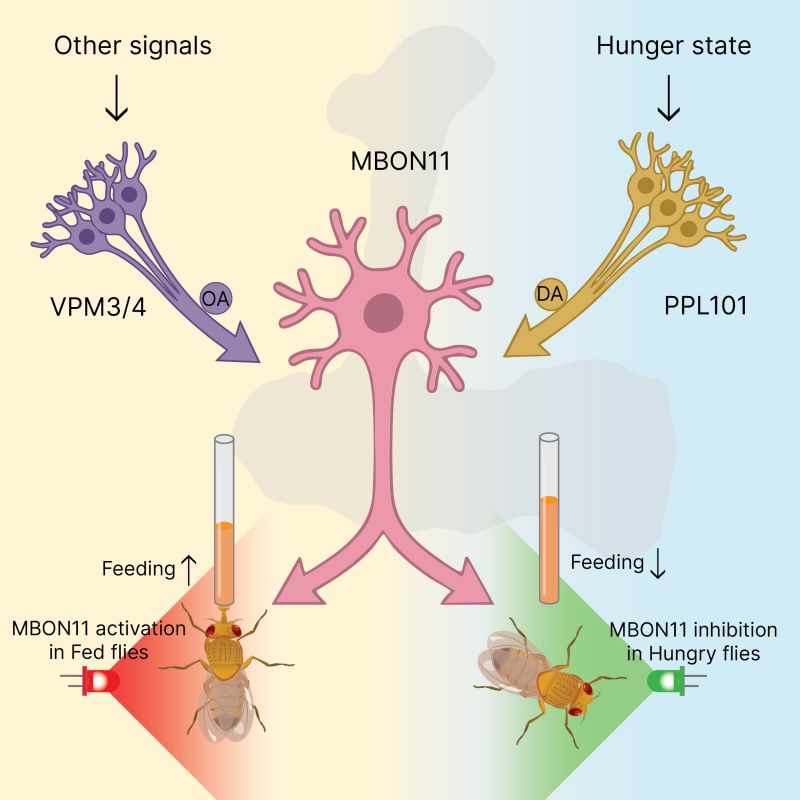
That’s essentially what we found in the vinegar fly (Drosophila). A neuron called MBON11 in the fly brain, can drive feeding behavior in both directions. Activate this cell with red light and flies eat more, even if they’re full. Silence this neuron with green light, and hungry flies eat much less.
Curiously, MBON11 is located in the mushroom body, which is the brain region flies use to learn and remember. We show that it also directly controls the drive to eat, drawing the picture that memory circuits are intimately involved in feeding decisions and, seemingly, hunger itself.
We found that two different chemical signals feed into this neuron. Adrenaline-like octopamine can increase feeding without being strictly necessary, while dopamine is required for hunger to translate into eating, but can’t override a full stomach on its own. MBON11 receives both of these types of signals.
A methodological note: we used a feeding assay that directly measures consumption, and instead of relying on a single feeding metric, we used multi-dimensional ‘phenovectors’, and contextualized them against natural hunger and satiety states. This gave us a richer, holistic picture of how different circuit manipulations affect feeding patterns overall.
Proud of Xianyuan Zhang and the whole team on this one. 🎉
Preprint out now: https://doi.org/10.64898/2026.03.13.711740
Xianyuan Zhang, Sangyu Xu, Joses Ho, James C. Stewart