Repeated Measures: A Better Way
Why your repeated-measures data deserves better than a simple line
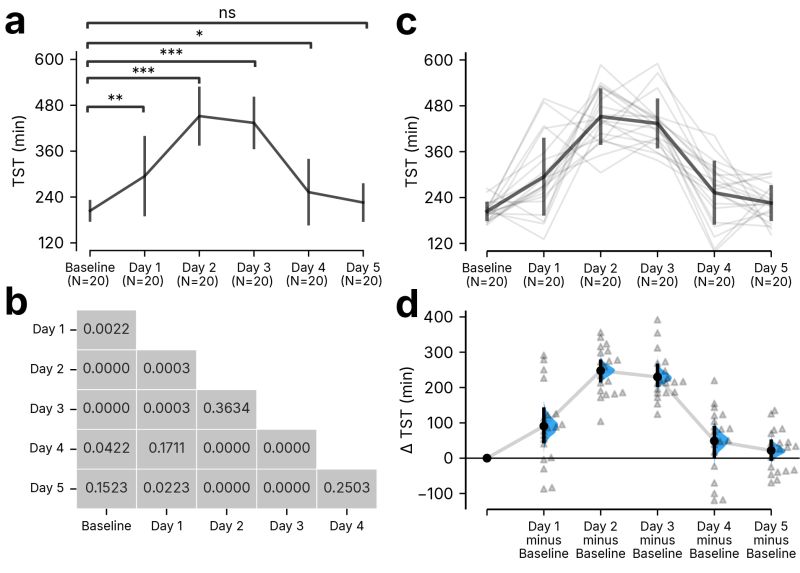
Whenever the same subjects are measured more than once, whether across timepoints, doses, or conditions, you have a repeated-measures design. It’s one of the most common frameworks in biomedical research. Yet research papers typically reduce these experiments into a mean line with error bars and P-values (Fig. 1A).
So, what’s missing? The individual trajectories. The sense of variability. The actual magnitude of change.
In addition, the typical analysis approach entails a combinatorial explosion of post-hoc tests computing every possible pairwise comparison (Fig. 1B), many of which are not relevant to your hypothesis and unnecessarily inflate your multiple comparisons burden. The questions that actually motivated the study (when does the effect begin?, how large does it grow?, and does it persist?) are obfuscated.
Our new software, DABEST 2.0, is designed around a different approach: keep the individuals, and draw the overall shape. Our repeated-measures figure has two panels doing two distinct jobs. The upper panel shows observed values and their dispersion, an attribute of the sample (Fig. 1C). The lower panel shows the bootstrap distribution of the effect at each timepoint, an inference of precision that sharpens as the sample grows (Fig. 1D).
With DABEST 2.0, you can:
— Visualise each subject’s individual trajectory alongside the means.
— Report the effect size with confidence intervals for the comparisons you care about.
— Show the full distribution of differences.
The result is a figure that more clearly quantifies (in a pretty way!) what changed, for whom, and by how much.
Preprint: https://doi.org/10.64898/2026.01.26.701654
Code: https://github.com/ACCLAB/DABEST-python
Work in collaboration with: Zinan Lu, Yishan Mai, Sangyu Xu, Nicole Lee, Hyungwon Choi, Adam Claridge-Chang, and others.