Mini-Meta to Summarize All Internal Results
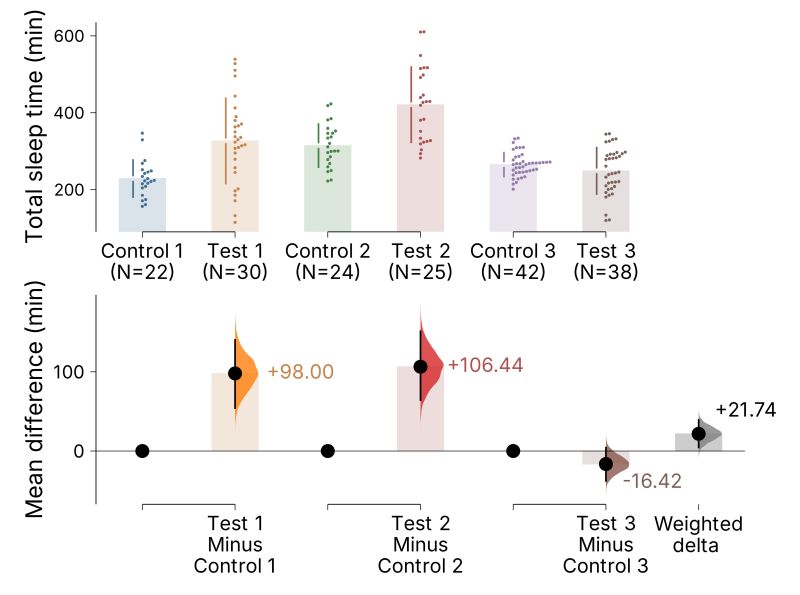
A difficult question I ran into early in my PhD was: When multiple experimenters do the same experiment but produce different results, what do you do?
Many would either cherry-pick the “best” replicate or blindly average results; the first conceals data while the second is statistically unsound. To solve this problem, we developed mini meta-analysis for DABEST 2.0, which lets you synthesize results from internally replicated experiments. It allows you to:
— Visualize effect sizes from each replicate
— Compute a weighted meta-analytic effect
— See the consistency (or heterogeneity) across your replicates
So next time you and your colleagues have the urge to argue on whose replicate is more “correct”, consider using mini meta-analysis to combine your data into a single, meaningful conclusion, while maintaining transparency in data reporting.
Preprint: https://doi.org/10.64898/2026.01.26.701654
Code: https://github.com/ACCLAB/DABEST-python
Work in collaboration with: Zinan Lu, Jonathan Anns, Sangyu Xu, Nicole Lee, Hyungwon Choi, Adam Claridge-Chang, and others.